Mining History with Superintelligence
ChatGPT has a remarkable ability to read, transcribe and illustrate historic documents and century-old newspaper and magazine stories. We're exploring new ways to create intellectual property.

I spent most of yesterday afternoon in front of a microfiche reader on the second floor of Saratoga Springs Public Library.
I had gone looking for one story in particular: The Saratogian’s account of February 23, 1923.
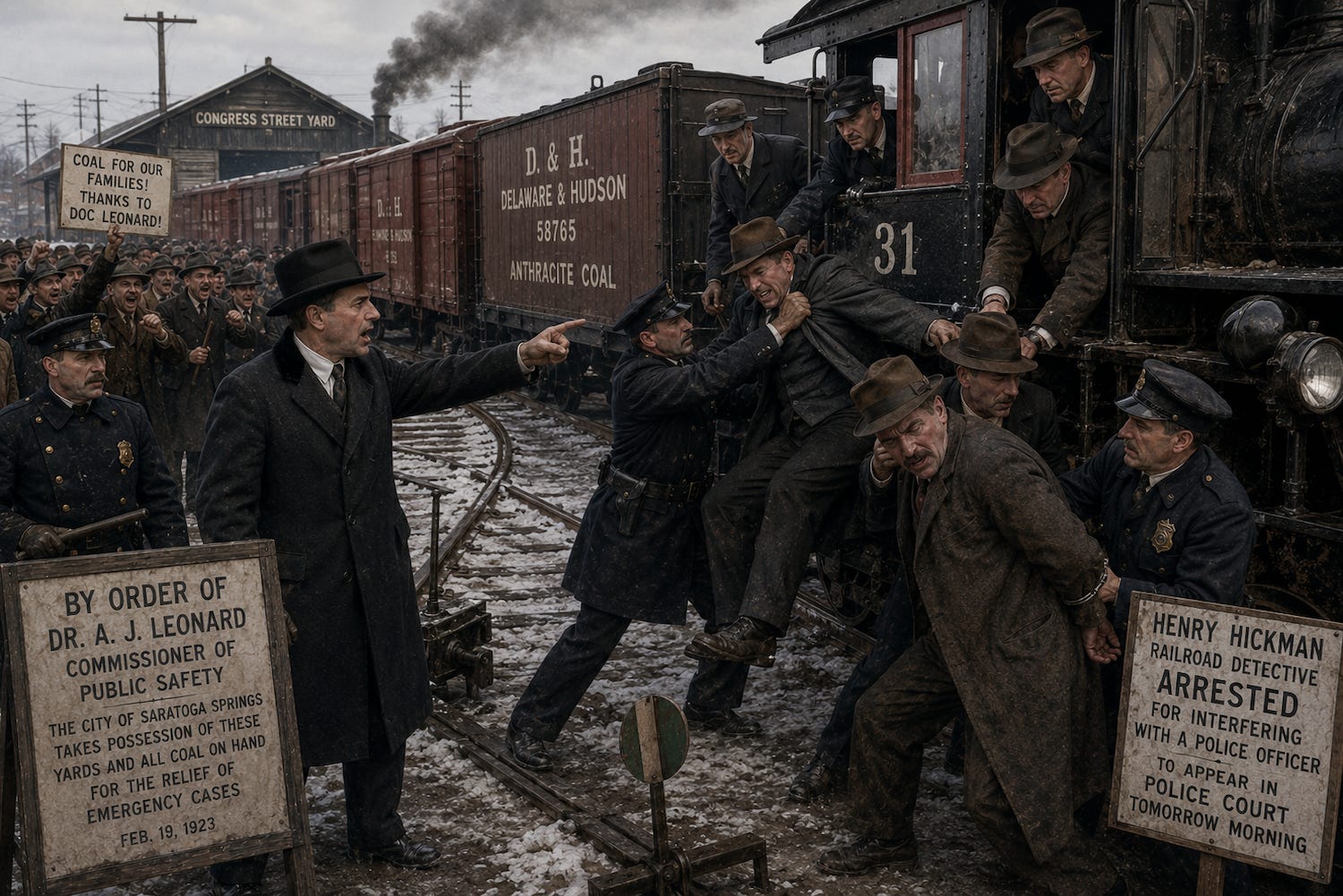
That was the remarkable day when A. J. “Doc” Leonard, Saratoga Springs’ Democratic Commissioner of Public Safety, seized nine railroad carloads of coal sitting in the Saratoga Coal Yard. Hospitals and schools were running out of fuel. Families were growing desperate as one of the coldest winters in memory tightened its grip on the city. Temperatures had fallen to ten below zero. This was no ordinary political dispute. It was a full-blown civic emergency confronting the leadership of Saratoga Springs.
It also provides the opening scene of Peter Finley’s Fight for the Rule of Law, the centennial project the Smartacus Story Accelerator is producing through October 1—the eve of the Saratoga Book Festival. By then, we hope to have completed the first phase of a much larger experiment in AI-assisted civic journalism and public history.
We’re producing Peter Finley’s Fight for the Rule of Law in two seasons.
Season One, now underway, introduces the two dominant political figures who controlled Saratoga Springs during the Roaring Twenties: A. J. “Doc” Leonard, the Commissioner of Public Safety and head of the Democratic Party in Saratoga, and James “Jim” Leary, head of the Republican Party. Party didn’t mean much back then. They were united in their wanting to keep Saratoga “open,” to continue to operate in the “Saratoga Way.” Even the State Police knew that what happens in Saratoga stays in Saratoga and needs not be investigated.
In the language of the day, an open city was one where gambling, bootlegging, prostitution, and other forms of organized vice were tolerated—or at least permitted to flourish with little official interference. It was an environment in which figures such as Arnold Rothstein, Meyer Lansky, Dutch Schultz, and a host of lesser-known bootleggers, bookmakers, and gamblers could conduct business in plain sight.
Season Two begins on July 23, exactly one hundred years after Peter Finley, president of the Saratoga Taxpayers Association, launched his campaign against corrupting in an open letter to Gov. Al Smith. Frustrated by years of official indifference, Finley set out to dismantle the political machine that had made Saratoga’s “open” reputation possible. And he won.
We’re calling our story “Saratoga’s Boardwalk Empire,” and we’re inviting the entire Saratoga community to join us in celebrating this outstanding Saratoga City. We’re promoting Peter Finley Appreciation Day and we’re hoping everyone will get on board.
Building a ‘Knowledge Refinery’
But this project is about more than the history of Saratoga. It is also about the future of writing, journalism, fiction, and art.
Between now and October 1, we are building what amounts to a digital knowledge refinery inside NotebookLM. Into it we are gathering every relevant authenticated newspaper account, government document, photograph, map, memoir, and expert interview we can obtain through the growing collaboration among our region’s museums, historical societies, libraries, and scholars.
At the center of this effort. Anyone wishing to understand Saratoga Springs during the Roaring Twenties and Prohibition should begin with Greg Veitch’s A Gangster’s Paradise: Saratoga Springs from Prohibition to Kefauver.
Greg has generously given Smartacus permission to build upon his extensive research, with one important condition: he retains the final editorial word on anything derived from his work. This partnership gives us confidence that we can combine historical scholarship with emerging AI tools while maintaining rigorous standards of accuracy.
Step One
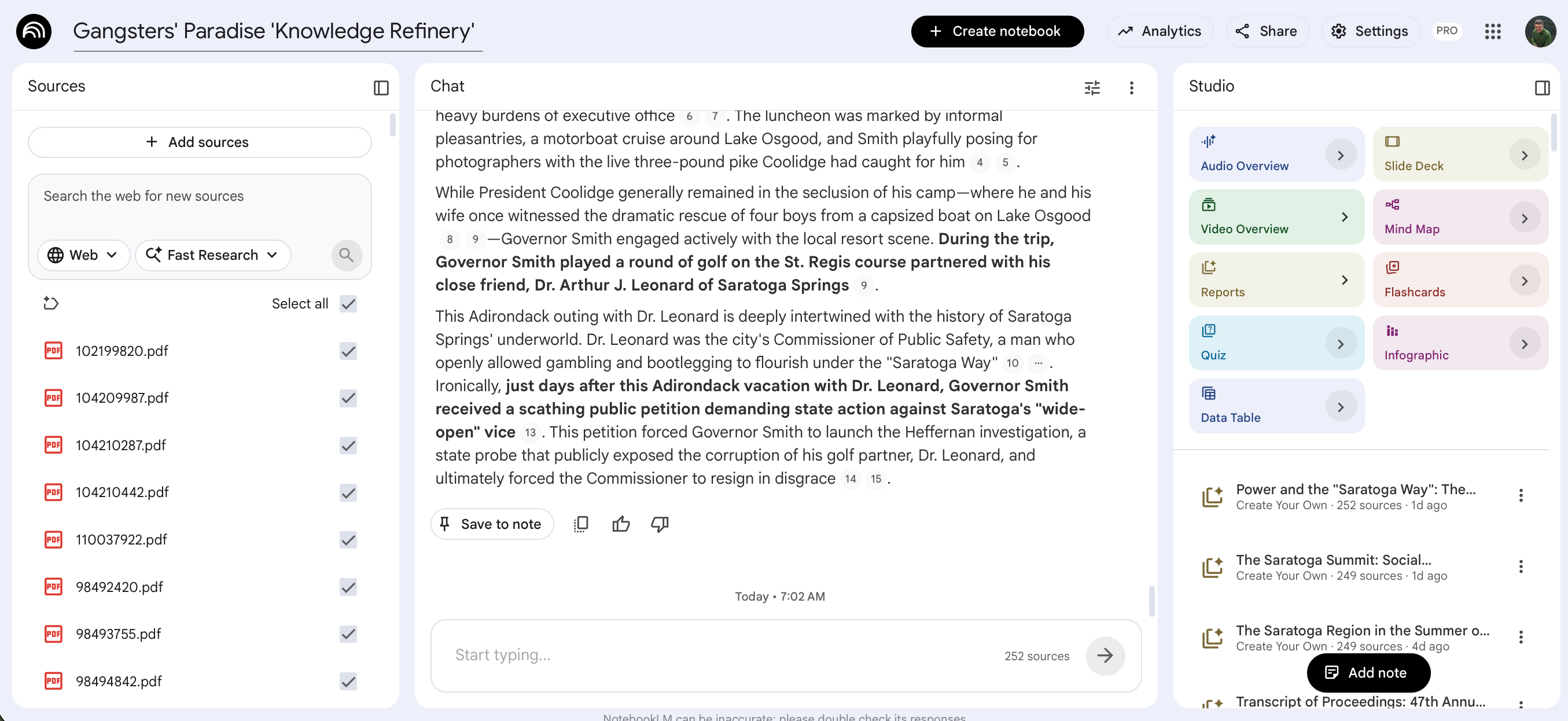
Our first step is creating what we call the Gangster’s Paradise Knowledge Refinery—a NotebookLM workspace built from The Saratogian, The New York Times, Greg’s research, and many other primary and secondary sources.
This is its home page. Look closely and you’ll see we’ve amassed nearly 250 sources so far.
Step Two
Once assembled, that body of knowledge becomes remarkably versatile. The same carefully authenticated material can be transformed into many different forms:
A print-on-demand book
A self-guided GPS audio tour
A series of podcasts
A three-act play
A television pilot
Interactive classroom lessons
AI-assisted Civic Conversations
Historical characters who speak in their own authentic voices.
Each draws from the same verified sources while reaching audiences in entirely different ways.
On October 1, we aim to introduce the first group of Skidmore students who will help us explore these possibilities. Together with STQRY, the Academy for Lifelong Learning, and—hopefully—the Saratoga Writers Center, we plan to launch workshops in Spatial Storytelling with AI and GPS, demonstrating how artificial intelligence can help communities preserve, interpret, and experience their own history.
The Future of Writing:
A Conversation with Rachel Baum
Monday evening’s Civic Conversation with Rachel Baum fits squarely into this larger initiative. We want to explore what she thinks the arrival of superintelligence means for writers.
That and more. Her interests and background are immensely diverse.
Award-winning poet and writer, with more than 90 poems published in respected literary journals and recognition including a Best of the Net nomination.
Former President of the New York Library Association, reflecting a lifelong commitment to expanding access to knowledge and strengthening public institutions.
Former Assistant Dean of the College of Computing and Information at the University at Albany, where she helped guide academic programs at the intersection of technology and information.
Certified professional dog trainer and founder of The At Home Dog Trainer, LLC, whose popular Times Union column, “BARK! Confessions of a Dog Trainer,” translated behavioral science into practical wisdom for pet owners.
Who knows where to start this conversation? I’m thinking an easy one. Like, How was your trip to Alaska?
AI is Opening New Creative Opportunities
Here’s a major focus we’ll want to explore with Rachel. Rather than fearing AI, shouldn’t creators be celebrating the new possibilities that superintelligence is creating? And shouldn’t we be learning everything we can about AI to ensure that it’s deployed with maximum regard for the interests of humanity?
Here’s the example I offer in my own experience. Look at the possibilities already emerging through GPS-triggered historical experiences like Voices of Lake Luzerne. Imagine similar Smart History Tours bringing life historic characters throughout the country. Books are great, but now we can tell the same stories spatially, triggering chapters with GPS markers. That’s a more compelling way to experience history. Both offered as companions is best.
Consider also the AI-augmented Civic Conversations we’re producing with Smartacus. Consider the work of local experts whose knowledge can now be captured, organized, connected, and shared in ways that simply weren’t possible even a few years ago. It’s a new form of civic journalism that Larry Toole already is demonstrating with impressive results at the Saratoga Civic Pulse.
Mining History with AI
I spent yesterday afternoon at the library not because artificial intelligence replaces original research, but because the better the evidence we feed these new systems, the more powerful they become as partners in discovery and storytelling.
We’re not automating history. We’re mining it.
And with today’s emerging AI, we now possess the most powerful tools ever devised for transforming the documentary record into books, audio tours, podcasts, classrooms, conversations, and experiences that help communities understand who they are and how they came to be.
With all of that said, it’s time we go back in history.
The temperature has fallen to ten below zero. The city’s coal bins are nearly empty. And A. J. “Doc” Leonard is about to make the bravest and more consequential decision of his career.